No products in the cart.
As demand for natural and organic products grows, more people are looking closely at what goes into their skincare. But what really is the difference between natural cosmetics and mass-market products, and which is better for your skin? In this article we compare the two and explain what to look for on the label.
In this article:
- What Are Natural Cosmetics?
- What Are Mass-Market Cosmetics?
- Key Differences at a Glance
- Is Natural Always Better?
- How to Choose Quality Skincare
- Frequently Asked Questions
What Are Natural Cosmetics?
Natural cosmetics are formulated mainly with ingredients of natural origin: plant extracts, plant oils and butters, essential oils, minerals and ingredients obtained by fermentation. These ingredients are often sourced from organic or sustainable farms, and natural brands usually avoid harsh detergents, heavy synthetic fragrances and unnecessary fillers.
Because they contain more nourishing, skin-friendly components, natural formulas are often gentler and work well for everyday care, especially for dry and sensitive skin.
What Are Mass-Market Cosmetics?
Mass-market cosmetics are produced in very large volumes and sold at low prices. To keep costs down, many of these products rely on inexpensive bases such as mineral oil and petrolatum, strong fragrances, high levels of preservatives and only small amounts of active ingredients. They are not dangerous, but they often do less for your skin, and some components, such as fragrances and harsh surfactants, can irritate sensitive skin.
Key Differences at a Glance
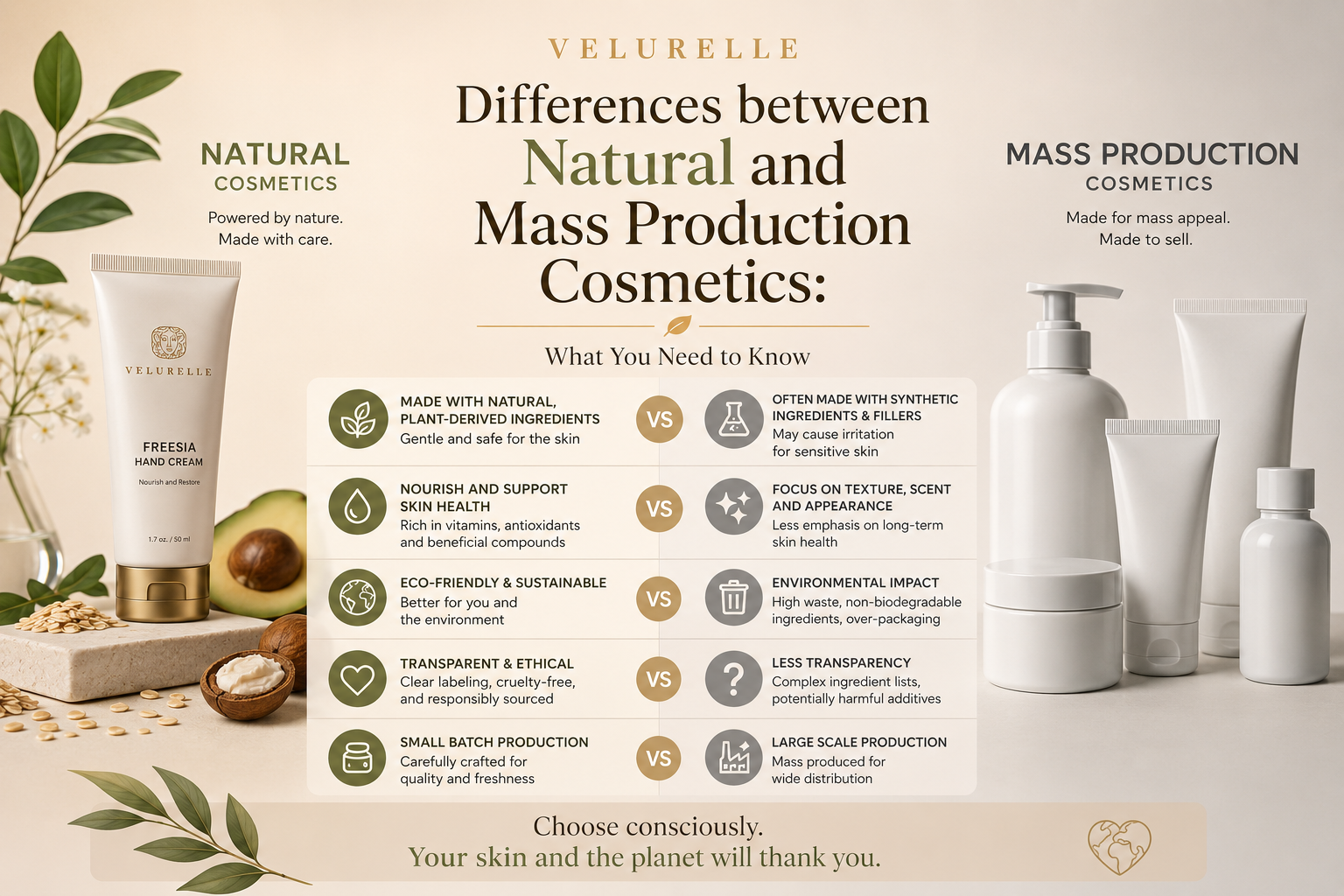
- Ingredients: natural cosmetics rely on plant-based and naturally derived ingredients; mass-market products more often use cheap synthetic bases and fillers.
- Concentration of actives: premium natural brands typically include meaningful amounts of active ingredients, while mass-market formulas often contain them only in small amounts.
- Fragrance: natural products tend to use little or no synthetic fragrance.
- Environmental impact: natural brands usually pay more attention to sustainable sourcing and biodegradable ingredients.
- Ethics: many natural brands are cruelty-free and don’t test on animals.
Is Natural Always Better?
Not automatically. “Natural” doesn’t mean allergy-free: essential oils and plant extracts can also cause reactions in sensitive skin. And some of the most effective, well-researched skincare ingredients – such as peptides like Argireline and Matrixyl 3000 – are created in laboratories. They are safe, skin-identical and gentle, and they deliver results that plant extracts alone can’t.
The best skincare combines both worlds: nourishing natural ingredients plus proven actives in effective concentrations. That’s the approach we take at Velurelle – for example, our Firming Night Cream pairs argan oil, macadamia nut oil and squalane with the peptide Matrixyl 3000.
How to Choose Quality Skincare
- Read the ingredient list. Ingredients are listed in descending order of concentration, so the first five make up most of the formula.
- Look for proven actives such as hyaluronic acid, peptides, niacinamide and antioxidants.
- Avoid heavy fragrance if your skin is sensitive.
- Check for cruelty-free claims if animal welfare matters to you.
- Patch-test new products on a small area of skin before using them on your face.
Choosing the right products for your skin type is the first step to avoiding the most common skincare mistakes.
Frequently Asked Questions
What are natural cosmetics?
Products made mainly from ingredients of natural origin, such as plant extracts, oils and minerals, often sourced from organic or sustainable farms.
Are natural cosmetics better for sensitive skin?
They are often gentler, but natural doesn’t mean allergy-free. Always check the ingredient list and patch-test a new product first.
Are synthetic ingredients bad for the skin?
No. Many effective, well-studied ingredients, such as peptides and hyaluronic acid, are made in laboratories. What matters is the quality of the formula as a whole.
Are natural cosmetics cruelty-free?
Many are, but not all. Look for products that are clearly labeled cruelty-free.
Natural Care, Proven Results
Discover Velurelle skincare – nourishing natural ingredients combined with proven actives like peptides and hyaluronic acid.